


RESEARCH & REPORTS
March 2026 — FinTech Australia Landmark Report
Impact of Fintech in Australia, Unlocking Australia’s Financial Future
The first comprehensive analysis of the economic contribution of the Australian fintech sector
Key findings:
The Australian fintech sector contributed $13.6 billion in 2024–25 in direct value to the economy, equivalent to 0.5% of GDP. Its direct contribution to GDP could grow to $37 billion by 2035.
The sector employs 50,200 FTE directly and supports a total of 109,200 FTE jobs including upstream supply chains.
It encompasses more than 800 fintechs operating across 13 subsectors, including digital payments, lending, InsurTech, WealthTech, RegTech and digital identity.
The majority (78%) of fintechs operate as B2B or B2B2C providers, embedding technology within other industries.
Fintechs identified their strongest areas of impact as improving business productivity (79%), driving innovation (77%) and enhancing consumer outcomes (66%).
Around half also cited financial inclusion and system integrity as key areas where they deliver broader social and economic value.
Supported by Mastercard and Open Finance ANZ
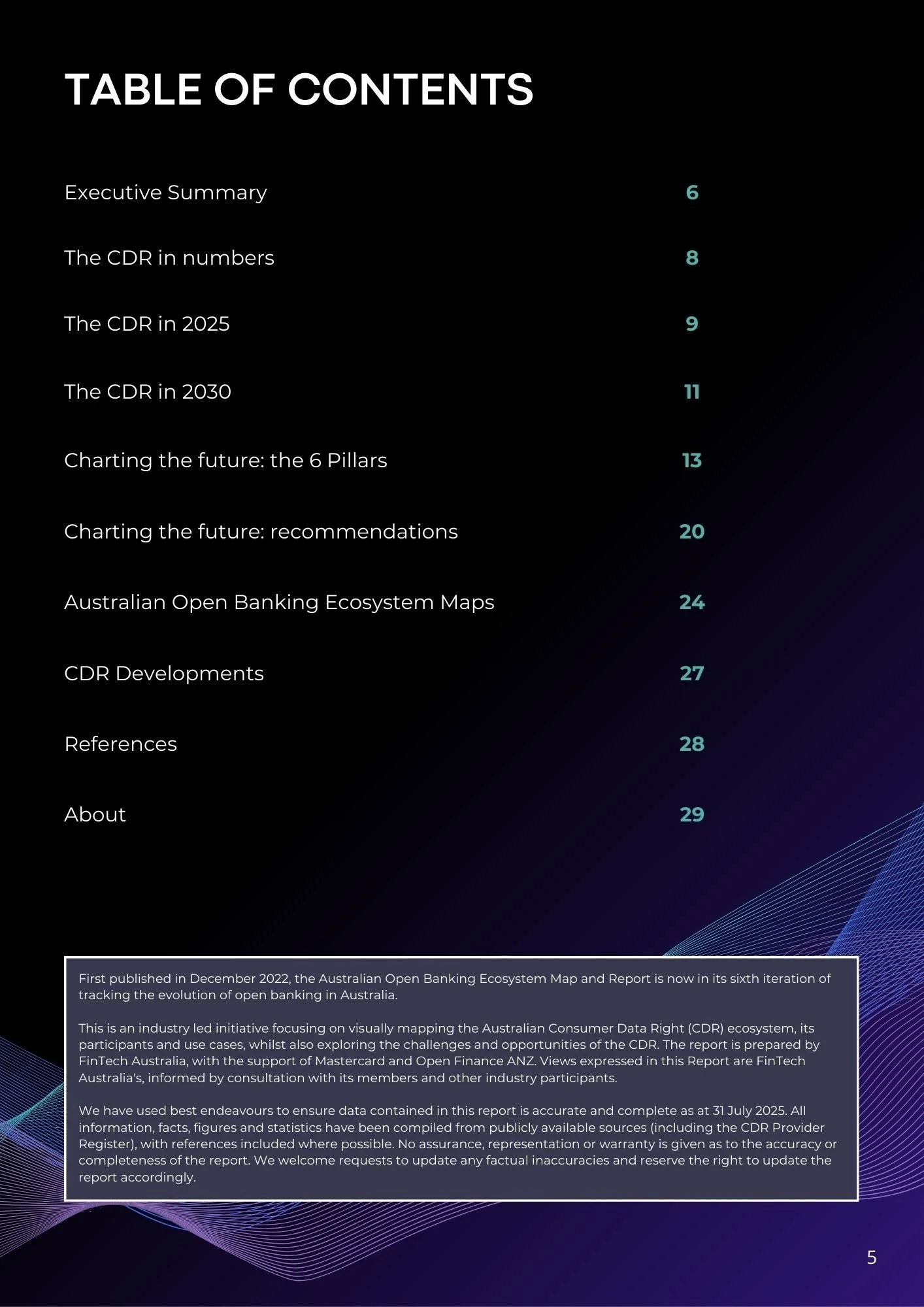
Australia Open Banking Ecosystem Report & Map — 6th Edition, September 2025

Key findings from the report include:
530,000 Australians were actively using Open Banking products and services in the second half of
2024 and an estimated 3-4% of eligible Australians are using by the end of 2025
582 million data requests were made in the second half of 2024, reflecting growing system use
190 registered software products now operate across sectors like healthcare, energy, and public services
Government and industry pilots, including Treasury’s rental data initiative, are showcasing the
Open Banking’s cross-sector potential
January 2025 — FinTech Australia Payments Report In Partnership with Mandala
Unlocking Growth: How Fintech Payment Solutions Empower Small Businesses

Key Findings:
Small businesses have gained $9 billion from fintech adoption—$8B in revenue growth and $1B in cost savings.
Over 30% of businesses reported revenue growth of over 2.5% after adopting a fintech payment solution.
More than half (56%) of small businesses now use fintech providers for in-person transactions, with a similar uptake (57%) in regional areas.
November 2023
EY CENSUS 2023
FinTech Australia has continued its successful collaboration with EY Australia to deliver this important piece of research. The Census remains the only detailed, industry-backed analysis of the Australian fintech industry, offering fine-grain detail about the industry’s increased maturity.
The eighth EY FinTech Australia Census finds more fintechs post-revenue than ever before, but challenges emerge for new entrants. A massive 88% of fintech respondents reported that they are post-revenue – the highest proportion recorded since the Census’ inception – and 43% are now turning a profit, compared with 30% last year. However, these positive findings are slightly tempered by the fact that the Census found significantly fewer younger companies in the fintech ecosystem. Just 3% are one year or younger, compared with 10% in 2022, suggesting that start-ups may be facing significantly higher barriers to entry than they were 12 months ago.

In brief
After a decade of being a focused government priority, Australia’s fintech sector is demonstrating growing maturity and record-breaking success.
But limited local capital, complex regulatory hurdles and overseas direct investment strategies are tempting success stories to focus their efforts offshore.
Modern digital regulation and reinforced support for start-ups would allow Australia to establish itself as a home to fintechs of the future.